 Live
Live
Über den Ort
Lokaler Kontext
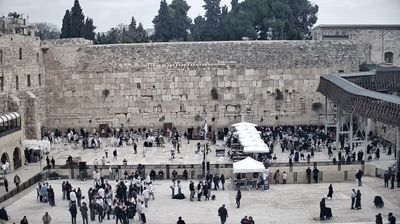
Jerusalem is a city in the Southern Levant, on a plateau in the Judaean Mountains between the Mediterranean and the Dead Sea. It is one of the oldest cities in the world and is considered a holy city to the three major Abrahamic religions: Judaism, Christianity and Islam. Both Israel and Palestine claim Jerusalem as their capital city; Israel maintains its primary governmental institutions there, while Palestine ultimately foresees it as its seat of power. Neither claim is widely recognised internationally. Throughout its long history, Jerusalem has been destroyed at least twice, besieged 23 times, captured and recaptured 44 times, and attacked 52 times. The part of Jerusalem called the City of David shows first signs of settlement in the 4th millennium BCE, in the shape of encampments of nomadic shepherds. During the Canaanite period (14th century BCE) Jerusalem was named as Urusalim on ancient Egyptian tablets, probably meaning "City of Shalem" after a Canaanite deity. During the Israelite period, significant construction activity in Jerusalem began in the 10th century BCE (Iron Age II), and by the 9th century BCE the city had developed into the religious and administrative centre of the Kingdom of Judah. In 1538 the city walls were rebuilt for a last time around Jerusalem under Suleiman the Magnificent of the Ottoman Empire. Today those walls define the Old City, which since the 19th century has been divided into four quarters—the Armenian, Christian, Jewish and Muslim quarters. The Old City became a World Heritage Site in 1981, and is on the List of World Heritage in Da
Verzeichnisquelle
Externe Live-Seite
Öffne das ursprüngliche Verzeichnisziel in einem neuen Tab.
Externe Seite öffnenIn der Nähe und empfohlen
Live-Webcams weltweit

Live vorgestellt
Broadcaster-Profile


Orte entdecken
Globales Verzeichnis
Africa
Antarctica
Asia
Europe
North America
Oceania
South America