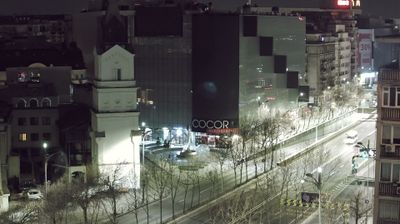
 Live
Live
Informazioni sul luogo
Contesto locale
Bucharest (Romanian: București [bukuˈreʃtʲ] ) is the capital and largest city of Romania. The metropolis stands on the River Dâmbovița in south-eastern Romania. Its population is officially estimated at 1.71 million residents within a greater metropolitan area of 2.31 million residents, which makes Bucharest the 9th most-populous city by population within city limits in the European Union. The city has an area of 240 km2 (93 sq mi), while the metropolitan area covers 1,811 km2 (699 sq mi). The city proper is administratively known as the "Municipality of Bucharest" (Romanian: Municipiul București), and has the same administrative level as that of a national county, being further subdivided into six sectors, each governed by a local mayor. Bucharest is a major cultural, political and economic hub, the country's seat of government, and the capital of the Muntenia region. It is an enclave completely surrounded by Ilfov County. Bucharest was first mentioned in 1459, and became a center of Wallachian commerce and governance in the 16th and 17th centuries. The city became the capital of the Romanian United Principalities in 1862, and boomed after the 1881 founding of the Romanian Kingdom. In the following decades, the city became known for its cosmopolitanism and eclectic architecture, being nicknamed "Paris of the East". However, it was severely damaged in the Second World War. Under the Socialist Republic of Romania, the city again grew massively in population and area, and new developments were characterized by socialist architecture and planning, particularly Nicolae Ceaușesc
Fonte della directory
Pagina live esterna
Apri la destinazione originale della directory in una nuova scheda.
Apri pagina esternaNelle vicinanze e consigliati
Webcam live nel mondo
Live in evidenza
Profili broadcaster


Scopri luoghi
Directory globale
Africa
Antarctica
Asia
Europe
North America
Oceania
South America