 En direct
À propos du lieu
Contexte local
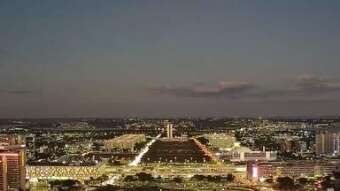
Brasília ( brə-ZIL-ee-ə, Brazilian Portuguese: [bɾaˈziliɐ, bɾaˈziljɐ] ) is the capital city of Brazil and the Federal District. Located in the Brazilian Highlands in the country's Central-West region, it was founded by President Juscelino Kubitschek on 21 April 1960, to replace Rio de Janeiro as the national capital. Brasília is Brazil's third-most populous city after São Paulo and Rio de Janeiro, with a population of 2.8 million. Among major Latin American cities, it has the highest GDP per capita. Brasília is a planned city developed by Lúcio Costa, Oscar Niemeyer and Joaquim Cardozo in 1956 in a scheme to move the capital from Rio de Janeiro to a more central location, which was chosen through a committee. The landscape architect was Roberto Burle Marx. The city's design divides it into numbered blocks as well as sectors for specified activities, such as the Hotel Sector, the Banking Sector, and the Embassy Sector. Brasília was inscribed as a UNESCO World Heritage Site in 1987 due to its modernist architecture and uniquely artistic urban planning. It was named "City of Design" by UNESCO in October 2017 and has been part of the Creative Cities Network since then. It is notable for its white-colored, modern architecture, designed by Oscar Niemeyer. All three branches of Brazil's federal government are located in the city: executive, legislative and judiciary. Brasília also hosts 124 foreign embassies. The city's international airport connects it to all other major Brazilian cities and some international destinations, and it is the third-busiest airport in Brazil. It was on
Source de l’annuaire
Page externe en direct
Ouvrez la destination d’origine dans un nouvel onglet.
Ouvrir la page externeÀ proximité et recommandés
Webcams en direct du monde
En direct à la une
Profils de diffuseurs


Découvrir des lieux
Annuaire mondial
Africa
Antarctica
Asia
Europe
North America
Oceania
South America